Legacy of the Incas
Machu Picchu Luxury Tours
Peru:
Machu Picchu - Lake Titicaca
(11 days/10 nights)
Machu Picchu Luxury Tours
Peru:
Machu Picchu - Lake Titicaca
(12 days/11 nights)
Empire of the Sun
Machu Picchu Luxury Tours
Peru:
Machu Picchu - Lake Titicaca
(14 days/13 nights)
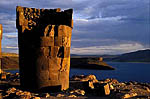
Ancient Civilizations of Peru
Machu Picchu Luxury Tours
Peru:
Colca Canyon - Machu Picchu
Lake Titicaca
(16 days/15 nights)
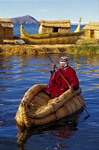
Archaeological & Ecological
Treasures
Machu Picchu Luxury Tours
Peru & Ecuador:
Galapagos - Machu Picchu
Lake Titicaca (or Amazon)
(18 days/17 nights)
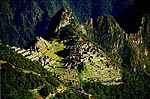
Grand Tour of the Inca Empire
Machu Picchu Luxury Tours
Peru:
Colca Canyon - Amazon
Machu Picchu- Lake Titicaca
(22 days/21 nights)
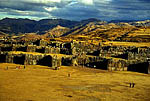
Ancient & Colonial Capitals
Machu Picchu Luxury Tours
Peru:
Machu Picchu
(10 days/9 nights)
Inca Trail to Machu Picchu
Machu Picchu Luxury Tours
Peru:
Machu Picchu
(13 days/12 nights)
Machu Picchu & Galapagos
Machu Picchu Luxury Tours
Peru & Ecuador:
Machu Picchu - Galapagos
(15 days/14 nights)
Galapagos & Machu Picchus
Machu Picchu Luxury Tours
Ecuador & Peru:
Galapagos - Machu Picchu
(18 days/17 nights)
Enchanted Isles of the Galapagos
Machu Picchu Luxury Tours
Ecuador:
Galapagos
(11 days/10 nights)
Galapagos & the Kingdom of Quito
Machu Picchu Luxury Tours
Ecuador:
Galapagos - Andes
(16 days/15 nights)
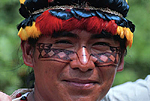
Galapagos & the Amazon
Machu Picchu Luxury Tours
Ecuador:
Galapagos - Amazon
(16 days/15 nights)
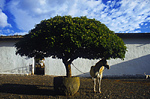
Historic Haciendas of the Andes
Machu Picchu Luxury Tours
Ecuador:
Cotopaxi - Antisana - Otavalo
(7 days/6 nights)
© 2013 Inka's Empire Corporation.
All rights reserved.
Luxury Galapagos Cruises
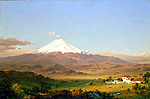
Frederic Edwin Church, Cotopaxi, 1855, oil on canvas, 28 x 42 inches.
Photo: Smithsonian American Art Museum. Luxury Galapagos Cruises.

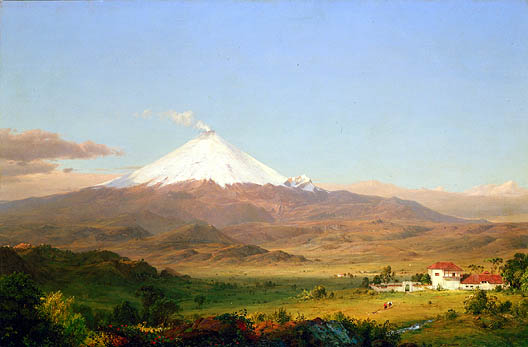
Volcanoes, islands and remnants of the Incas: an Ecuadorian odyssey...
-- Kimberly Fay, LuxuryLink.com
Land & Cruise Price (13 days/12 nights)
Imperial US$ 11,390 per person
The prices shown include a Superior Suite aboard the luxurious yacht La Pinta. Our tours also are available with other yachts or with a 7-night Galapagos cruise, instead of 4 nights. Please select a yacht to view details about each vessel and its itinerary.
When considering a Galapagos cruise, note that the islands are distinct in their flora and fauna. Certain islands provide a greater or unique opportunity for observing certain species. Thus, landings on more islands reveal more species and, importantly, the amazingly different adaptations each species has made to its own insular world. Accordingly, a 7-night cruise is preferable. It also offers a greater choice of luxury vessels.
The land and cruise price includes escorted transfers, private excursions with a professional guide and chauffeur on the mainland and semi-private excursions with a certified naturalist on the Galapagos Islands, your choice of activities at the Hacienda Zuleta, entrance fees, selected category of accommodations, gourmet cuisine, all land and water transportation, and travel insurance for guests through the age of 59 years (over that age, there is a supplementary fee). All prices are per person based on two people sharing a guest room. For a detailed description of our services, see Opulent Itineraries. Horse riding at the Hacienda San Agustin de Callo is available at additional cost.
Map
Intra-Tour Flights & Fares
Air fares are in addition to the land price.
Quito - Galapagos - Quito: US$ 440 per person
Select a Yacht
Luxury Galapagos Cruises
Cormorant
La Pinta, Galapagos Islands.
Photo: La Pinta. Luxury Galapagos Cruises.
Upon arrival in Quito, you will be escorted to the two-century-old Hacienda La Carriona, whose stone courtyard and garden hint of the exuberant Spanish colonial lifestyle. During a five-day overland excursion along the "Avenue of the Volcanoes", from Cotopaxi, the highest active volcano on earth, to Antisana, you will admire the magnificent landscape that inspired Frederic Edwin Church's epic paintings of the Andes.
Soak in the hot springs of Papallacta, visit authentic workshops in artisans' pueblos, "barter with the natives" in the mystical Otavalo Valley and recapture the spirit of old Spanish days while staying in two other historic haciendas: Zuleta, established in 1691, and San Agustín de Callo, the 15th century Inca palace from which Atahualpa ruled the Kingdom of Quito, now called Ecuador. As an Inka's client you will sleep in one of the Inca rooms. Who knows -- maybe even Atahualpa's!
Arriving back in Quito, you will be escorted to the palatial Casa Gangotena, then dine on fusion cuisine at Zazu. In Ecuador's capital, founded in 1534, walk along the cobblestone streets through centuries-old parks and plazas to churches filled with gold. Contemplate Gothic, Baroque, Moorish and Neo-Classical architecture, all blended with the mestizo sentiment, and imagine you've gone back in time to the astonishing colonial world. In the evening, take a horse-drawn carriage past the beautifully illuminated facades of the Spanish monuments, and savor vanguard Mediterranean cuisine at Theatrum.
A flight the next morning takes you from the peaks of the Andes to the Galapagos Islands. While yachting this extraordinary archipelago with a naturalist, go ashore amid volcanic landscapes, hike among Marine Iguanas and lava lizards, and have the rare opportunity of snorkeling among penguins and marine tortoises. On these enchanted isles, each with its unique wildlife, you can compare the adaptations of the species to their differing environments that inspired Charles Darwin's theory of evolution. Returning for your last night in Quito, experience the finest in Criollo cuisine at Astrid & Gastón.
For an appreciation of Ecuador's rainforest wildlife, consider one of our luxury Amazon expeditions.
What Luxury Link has to say about Galapagos & the Kingdom of Quito.
What You Could Add: Galapagos Safari Camp.
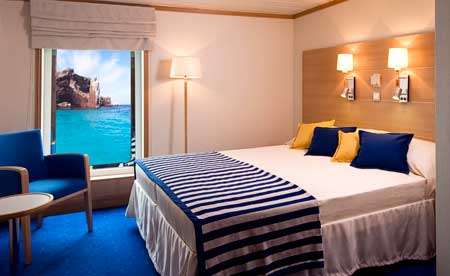
Cabin, La Pinta, Galapagos Islands.
Photo: La Pinta. Luxury Galapagos Cruises.
Highlights
Hacienda La Carriona
Day 1: Quito, Ecuador - Hacienda La Carriona. Transfer to the Hacienda La Carriona, a monument to Ecuador's colonial history. Dinner and overnight in the Hacienda La Carriona -- Suite.
Hacienda San Agustín de Callo
Day 2: Hacienda La Carriona - Quilotoa Crater Lake - Tigua - Hacienda San Agustín de Callo. Departure south to the extinct Quilotoa Volcano. If open today, visit a local market on the way. Look down into the Quilotoa Crater Lake and try to imagine its unfathomable depth. If you wish, hike down to the lake and ride back up on a mule. In this region, indigenous populations maintain crops at an elevation of over 4,000 m. (13,120 ft.). Others, the artists of Tigua, are the creators of Ecuador's most famous naïve paintings. Andean lunch made of local, organic ingredients at Posada de Tigua before returning on the Avenue of the Volcanoes to the Hacienda San Agustín de Callo, a 15th century Inca palace and 16th century colonial monastery for a walk on its historic grounds. Dinner and overnight in the Hacienda San Agustin de Callo -- Mulalo Suite, in the Inca palace.
Papallacta Hot Springs
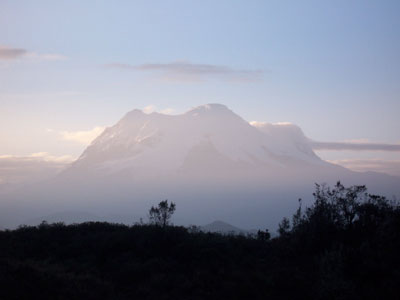
Day 3: Hacienda San Agustín de Callo - Cotopaxi National Park - Antisana Ecological Reserve - Papallacta Hot Springs. Morning departure to Cotopaxi, the highest active volcano on earth. Surrounding it, you will find the moorlands of the National Park. Exquisite landscapes are revealed as you hike the trails. Continue north along the Avenue of the Volcanoes toward the majestic Antisana Volcano. We view the panorama from a private reserve at cloud-forest level that is crowned by La Mica Lake, which teems with bird life. After a box lunch, hike with the snows of Antisana as a pristine backdrop. Then, drive to the Termas de Papallacta to enjoy the hot springs and natural surroundings. Dinner and overnight in the Termas de Papallacta Spa & Resort -- Double Room.
Hacienda Zuleta
Day 4: Papallacta Hot Springs - Cayambe - Hacienda Zuleta. Relax in the hot springs this morning and walk on marked paths, where nature lovers can appreciate the unique endemic species of flora and fauna. Around midday, departure north toward the Awakening Valley, home of the Otavalo Indians. In Cayambe, see how the pueblo's traditional biscuits and cheese are made, then visit the local "Middle of the World" Monument, marking the equator, and Rosen Pavillon, one of its first rose plantations. In the afternoon, drive along San Pablo Lake to Hacienda Pinsaquí. Lunch at Pinsaquí. Continue to the Hacienda Zuleta. Dinner and overnight in the Hacienda Zuleta -- Junior Suite.
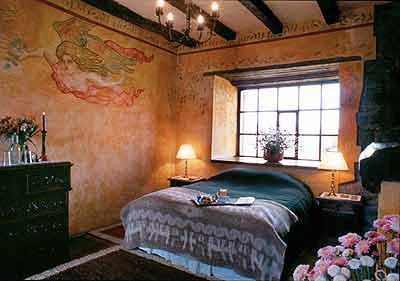
Day 5: Hacienda Zuleta. Tours of the entire farm, on foot or on horse, are a typical part of every guest's stay. Select your favorite hacienda activities, any of which are included with your visit. Of special interest to many guests are the archaeological sites, working farm, hand-embroidery workshop, condor rehabilitation project, trout farm, cheese factory and stables. The hacienda is as famous for its horses and riding program as it is for its history and hospitality. Lunch at the hacienda. Dinner and overnight in the Hacienda Zuleta -- Junior Suite.
Quito
Day 6: Hacienda Zuleta - Otavalo Indian Market - Hacienda Cusín - Cayambe - Quito. At the foot of the Imbabura Volcano, lies the valley of Otavalo. Visit the ruins of the Incan Sun Temple at Caranqui, then choose between two options. For those more interested in native cultures, visit the village of Peguche, where musical instruments and woolen tapestries are made, the nearby sacred waterfall and other artisans' pueblos. For those more interested in nature, drive up to Cuicocha Lake and hike around this flooded volcanic crater. Time to explore the Otavalo Indian market, which dates back to pre-Inca times. Lunch at the Hacienda Cusín. Continue to Cayambe's "Middle of the World" Monument, then see how the pueblo's traditional biscuits and cheese are made. Returning to Quito under the shadow of the Cayambe Volcano, arrive at the Casa Gangotena. Dine at Zazu. Overnight in the Casa Gangotena -- Plaza View Room.
Day 7: Quito. This morning, drive to the top of El Panecillo. Its summit overlooks Old Quito. Begin your walking tour of the colonial quarter, highlighted by La Plaza de la Independencia, the Cathedral, La Compañia de Jesús, La Iglesia de San Francisco and La Iglesia y Convento de la Merced. At the City Museum, see what daily life was like in colonial Quito.
Lunch at El Crater, inside the crater of the Pululahua Volcano. Our afternoon destination is Rumicucho, a late 15th century Inca fortress, observatory and temple of the sun. It was built near the equator, which the Incas called Intiñan (Path of the Sun). Before returning to Quito, go to the equator, where you can stand with one foot in the southern hemisphere and the other in the northern hemisphere.
As an alternative, you may choose an afternoon excursion to the Central Bank Museum.
This afternoon, a lunch at Café Tianguez. To complete your insight into the country's archaeology, history and cultures; investigate Ecuador's ancient past in the galleries of the Central Bank Museum.
This evening, return to El Panecillo for a panorama of the beautifully illuminated colonial quarter. Though not of colonial vintage, the neo-Gothic La Basílica is the place to see bizarre and fascinating gargoyles. Admire the night view of the Spanish monuments along Calle de las Siete Cruces, on the way to La Plaza de la Independencia, where you will board a horse-drawn carriage for a romantic ride through the narrow streets of Old Quito. Arrive at Theatrum to savor vanguard Mediterranean cuisine. Afterward, return to your hotel. Overnight in the Casa Gangotena -- Plaza View Room.
Galapagos
Day 8: Quito - Galapagos Cruise. Transfer to the airport. Flight to the Galapagos. Entrance into the National Park, reception and transfer to your yacht. Afternoon island landing and excursion with a naturalist. Back on board. Guides' briefing on the next day's activities. Overnight on La Pinta.
Days 9, 10 & 11: Galapagos Cruise. Morning and afternoon island landings and excursions with a naturalist. Back on board. Guides' briefing on the next day's activities. Overnight on La Pinta.
Quito
Day 12: Galapagos Cruise - Quito. Morning island landing and excursion with a naturalist. Transfer to the airport. Flight to Quito. Reception and transfer to your hotel. Dinner at Astrid & Gastón. Overnight in the Casa Gangotena -- Plaza View Room.
Home
Day 13: Quito - Home. Transfer to the airport for your flight home.
Exceptions to the itinerary:
The Galapagos cruise itinerary described and illustrated below is typical but varies by yacht. Therefore, it should be used only as a guide for learning about the different islands and their wildlife.
Details
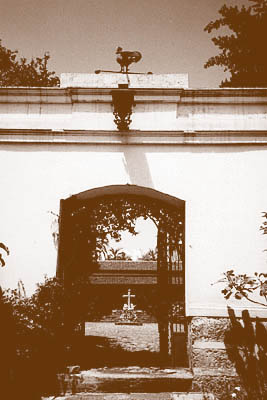
Entrance to the Hacienda La Carriona, Ecuador.
Photo: Hacienda La Carriona. Luxury Galapagos Cruises.
Its stone courtyard and garden hint of the exuberant Spanish Colonial lifestyle...
-- Kimberly Fay, LuxuryLink.com
Day 1: Quito, Ecuador - Hacienda La Carriona
Transfer to the Hacienda La Carriona, located in the beautiful Valley of Los Chillos, a brief drive south from Quito. Constructed more than two centuries ago, "La Carriona" stands as a monument to Ecuador's colonial history. Its stone courtyard and garden hint of the exuberant Spanish Colonial lifestyle, while its name reminds us that it once belonged to the renowned Carrión family. La Carriona's thick adobe walls have witnessed significant events in Ecuador's history. In the mid-1800s, the house belonged to the distinguished family, Fernández Salvador. In 1830, the patriarch of this family, Don José Fernández Salvador, was appointed president of the first Constitutional Assembly, which laid the foundation for both the Ecuadorian constitution and the nation. Today, the hacienda accommodates guests amidst tranquil surroundings. Dinner and overnight in the Hacienda La Carriona.
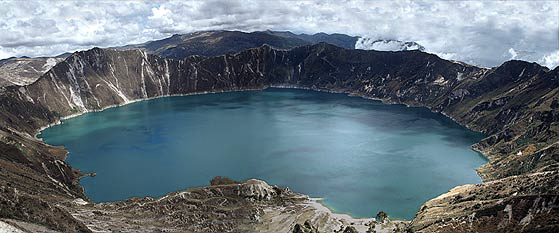
Quilotoa Crater Lake, Ecuador.
Photo: Nathou & Nono. Luxury Galapagos Cruises.
Day 2: Hacienda La Carriona - Quilotoa Crater Lake - Tigua - Hacienda San Agustín de Callo
Breakfast. Early morning departure south in private car with your guide and driver to the extinct Quilotoa Volcano, in a remote area of the high Andes on the western side of the Cotopaxi province. If open today, visit a local market on the way. After a drive up a dirt road and a hike to the rim, we'll look down into the dark green Quilotoa Crater Lake and try to imagine its unfathomable depth. At this majestic site, at the level of the clouds, we'll contemplate an extraordinary and rarely-seen landscape, not only into the volcano but out to the volcanoes surrounding Quilotoa. If you wish, hike down to the lake and ride back up on a mule.
In this region, indigenous populations maintain crops at an elevation of over 4,000 m. (13,120 ft.). Others, the artists of Tigua, whom we'll visit, are the creators of Ecuador's most famous naïve paintings.
"The Native American artists of Tigua, Ecuador have a short artistic history, but a very deep and rich cultural history. They are direct descendents of the Incan and pre-Incan populations who've inhabited this high Andean region for centuries...
The subject matter of these paintings usually reflects the immediately-surrounding Andean landscape and the traditional and ritualistic lifestyle of the native population. These scenes are rendered in a charming naif, folk style using bright, colorful enamel paints..."
-- Gordon Polatnick
Andean lunch made of local, organic ingredients at Posada de Tigua before returning returning on the Avenue of the Volcanoes to Salcedo and the Hacienda San Agustín de Callo, a 15th century Inca palace and 16th century colonial monastery. The view of Cotopaxi will make you feel you've entered one of Frederic Edwin Church's paintings. Indeed, the hancienda is depicted in the artist's Cotopoxi, of 1855.
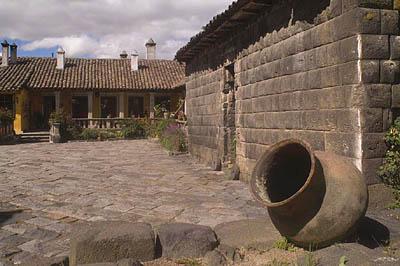
Courtyard of the Hacienda San Agustín de Callo, Ecuador.
Photo: Hacienda San Agustín de Callo. Luxury Galapagos Cruises.
Sleep in an Inca palace!
Continue to the ancient Hacienda San Agustín de Callo for a walk on its historic grounds. Around 1440 AD, the Inca emperor Tupac Yupanqui commanded the construction of a palace, and later his son, Huayna Capac, concluded the work. In turn, his son Atahualpa, the last of the Inca emperors and the king of Quito, occupied the palace on his travels to Quito and Cajamarca, before he was captured by the Spanish conquerors and executed in 1533.
The hacienda was written about by the Spanish chronicler Cieza de Leon in 1553, and is one of only two major Inca sites in Ecuador (the other is Ingapirca, near Cuenca). To this day, the remaining rooms prevail as a magnificent example of the unique style of Inca construction. The site is currently being investigated by Dr. David Brown of the University of Texas, with funding by the National Geographic Society. Previously unknown portions of Inca walls and foundations have been discovered throughout the restoration process of the house.
Las Gordas Room of the Hacienda San Agustín de Callo, Ecuador.
Photo: Hacienda San Agustín de Callo. Luxury Galapagos Cruises.
In 1590, the King of Spain granted large extensions of land to the religious orders in the different regions of Ecuador, with the purpose of consolidating the conquest and catholicizing the Indians. The Augustinian Order established their monastery in the region of Mulalo at this site, and with time constructed the colonial part of the house, blending the Spanish architectural style with the older Inca building.
In the 18th century, there was significant debate in the scientific community as to whether the circumference of the earth was greater around the equator or around the poles. To answer that question, Louis XV, the King of France, and the French Academy of Sciences sent the French Geodesic Mission to Ecuador (1736-44) for the purpose of measuring the roundness of the planet and the length of a degree of longitude at the equator. San Agustín de Callo housed the expedition's scientists, who witnessed two eruptions of Cotopaxi, in 1743 and 1744. In 1921, the hacienda was purchased by General Leonidas Plaza Gutierrez, president of Ecuador in 1901 and in 1912. The hacienda remains in the family and is currently owned by the general's granddaughter Mignon Plaza. Dinner and overnight in the Hacienda San Agustin de Callo.
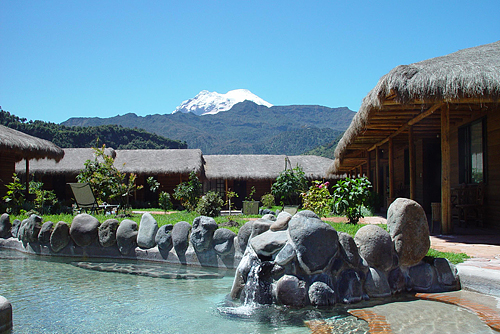
Antisana Volcano, as seen from the Papallacta Hot Springs, Ecuador.
Photo: Termas de Papallacta. Luxury Galapagos Cruises.
Day 3: Hacienda San Agustín de Callo - Cotopaxi National Park - Antisana Ecological Reserve - Papallacta Hot Springs
Breakfast. Morning departure to Cotopaxi. The white-coned summit of the perfectly symmetrical volcano takes pride of place along the Avenue of the Volcanoes. The glaciated summit is 5,907 meters, or 19,400 feet, above sea level, making it the highest active volcano on earth. Surrounding the "King of the Andes", you will find the moorlands of the National Park, a vast wilderness of sweeping plains. Its 85,000 acres protect Andean condors, llamas, spectacled bears and many other species of highland fauna and flora. Exquisite landscapes are revealed as you hike the trails.
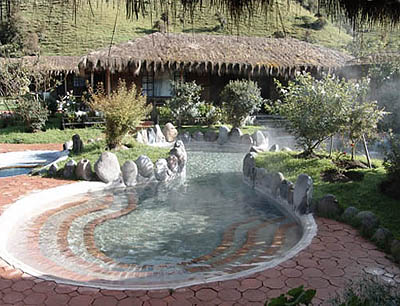
Termas de Papallacta hot springs, spa and resort, Ecuador.
Photo: Termas de Papallacta. Luxury Galapagos Cruises.
Continue north on the Avenue of the Volcanoes to the village of Píntag, where the eastern range of the Andes rises toward the majestic Antisana Volcano. We view the panorama from a private reserve that starts at cloud-forest level, where it is dominated by bamboos and bromeliads, and extends past the amazing lava flows of the volcano. The reserve's plateau is crowned by La Mica Lake, which teems with bird life -- caracaras, lapwings, Andean condors and hummingbirds. After a box lunch, hike with the snows of Antisana as a pristine backdrop. Then, drive to the Termas de Papallacta, on the eastern foothills of the Andes, to enjoy the hot springs and natural surroundings. Dinner and overnight in the Termas de Papallacta Spa & Resort.
Thermal pool, Termas de Papallacta Spa & Resort, Papallacta, Ecuador.
Photo:Termas de Papallacta Spa & Resort. Luxury Galapagos Cruises.
Day 4: Papallacta Hot Springs - Cayambe - Hacienda Zuleta
Breakfast. Relax in the hot springs this morning and walk on marked paths, where nature lovers can appreciate the unique endemic species of flora and fauna. Around midday, departure north toward the Awakening Valley, home of the Otavalo Indians. In Cayambe, see how the pueblo's traditional biscuits and cheese are made, then visit the local "Middle of the World" Monument, marking the equator, and Rosen Pavillon, one of its first rose plantations. The owner, María Eugenia Espinosa, will take you on a tour of this romantic place, which still maintains the tradition of women cultivating the roses by hand. Eighteen varieties are grown in six greenhouses, with each worker caring for and harvesting her own fifty beds. Six to eight-thousand stems a day are cut, most going to the United States.
Hacienda Pinsaquí, Otavalo, Ecuador.
Photo: Hotel Pinsaquí. Luxury Ecuador Tours & Travel.
In the afternoon, drive along San Pablo Lake to Hacienda Pinsaquí. Constructed in 1790, the hacienda was originally a colonial textile enterprise, employing over one thousand weavers and spinners. To this day, it retains the character and authenticity of its earlier incarnation. Over the centuries Pinsaquí has hosted numerous illustrious guests. Most famous of all is General Simón Bolívar, the revered liberator of Ecuador, who often spent the night at the hacienda on his trips to and from Bogotá, Colombia. Lunch at Pinsaquí.
Imbabura Volcano and San Pablo Lake, Otavalo Valley, Ecuador.
Photo: Mylene d'Auriol Stoessel. Luxury Galapagos Cruises.
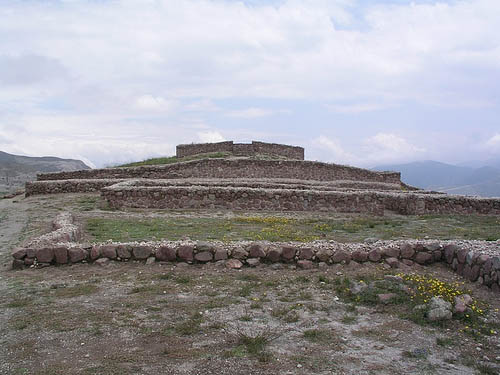
In the afternoon, drive along San Pablo Lake to the Hacienda Zuleta. Recently, Zuleta was opened to a limited number of guests so that the public could enjoy the many wonders it holds. To visit the hacienda is to experience four centuries of history steeped in Pre-Colombian, Spanish and Ecuadorian tradition. The original inhabitants of the Zuleta region were the peace-loving Caranquis, who have left a pyramid on the hacienda grounds. They were an agrarian-based culture and flourished in this area rich in volcanic soils from about 800 AD until the arrival of the war-faring Incas in the late 1470s. Although the Caranquis fought stoically against the Inca for forty years, they were eventually conquered and forced into Inca servitude. Yet Inca rule was short-lived. By 1533, the last Inca king, Atahualpa, had been captured and assassinated by the Spanish conquistador, Francisco Pizarro, leaving the Inca empire in collapse and a free-for-all for the land-hungry vassals of the Spanish Crown. The execution of Atahualpa by Pizarro marked the end of Inca domination in the Zuleta region, and the beginning of Spanish rule.
Courtyard of the Hacienda Zuleta, Ecuador.
Photo: Hacienda Zuleta. Luxury Galapagos Cruises.
In the late 16th century, King Carlos is believed to have bequeathed the Zuleta region to the Jesuits, who implemented their Spanish methods of farming and of cattle and sheep production. In the following years an "obraje" (small wool mill) was established. By 1691, the Hacienda house, granary and chapel were completed and the farm was in full operation. However, in 1713, under the direction of King Charles III, the property was confiscated and transferred to Canon Gabriel Zuleta, thus making Zuleta his seventeenth hacienda. From that day forth, the farm became known as Cochicaranqui de Zuleta. Upon the Canon's death, the farm passed to the Posse family, who were inspired to bring the hacienda back to its previous 17th century grandeur. Yet it wasn't until the farm was sold to Jose Maria Lasso in 1898 and passed through two more generations to Galo Plaza Lasso, the ex-President of Ecuador, bullfighter and diplomat, that Zuleta recaptured its original prosperity. Dinner and overnight in the Hacienda Zuleta.
Rolling hills of the Hacienda Zuleta, Ecuador.
Photo: Hacienda Zuleta. Luxury Galapagos Cruises.
Day 5: Hacienda Zuleta
Breakfast. Tours of the entire farm, on foot or on horse, are a typical part of every guest's stay. You are usually privately escorted by a Plaza family member, another gesture of Zuleta's renowned hospitality. Select your favorite hacienda activities, any of which are included with your visit. Of special interest to many guests are the archaeological sites, working farm, hand-embroidery workshop, condor rehabilitation project, trout farm, cheese factory and stables. The hacienda is as famous for its horses and riding program as it is for its history and hospitality. Riding has been a Plaza family tradition for over one hundred years, and today Zuleta reflects this equestrian affinity by boasting one of the most exclusive stables in Ecuador. The hacienda is known for its Zuleteño horse which is a unique mixture of Spanish-Andalusian, English and Quarter horses. The outcome of this cross-breeding is a robust Andean horse with a good disposition for riding. Lunch at the hacienda. Dinner and overnight in the Hacienda Zuleta.


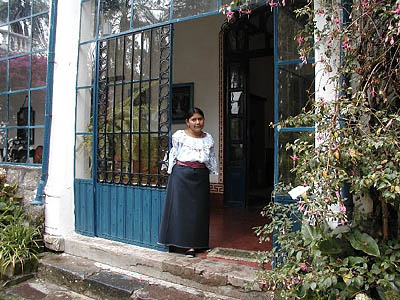
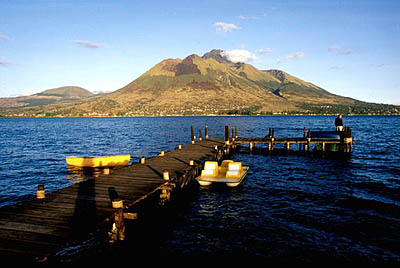
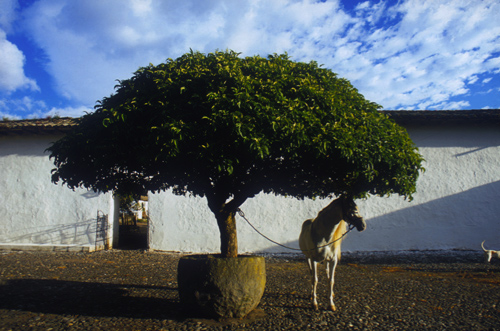
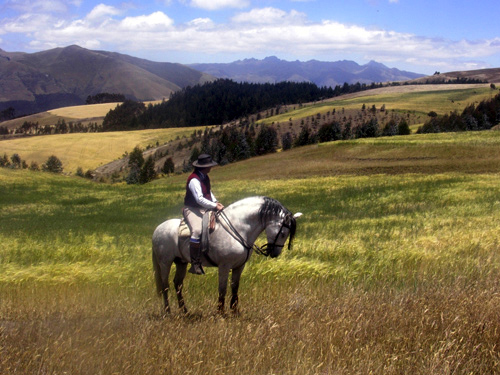
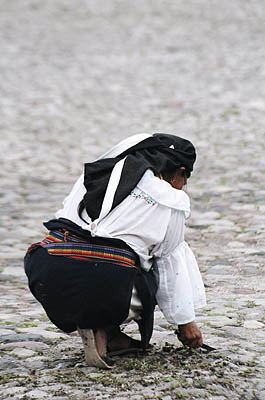
Otavaleña, Otavalo Valley, Ecuador.
Photo: Iolanda Costa. Luxury Galapagos Cruises.
Day 6: Hacienda Zuleta - Otavalo Indian Market - Hacienda Cusín - Cayambe - Quito
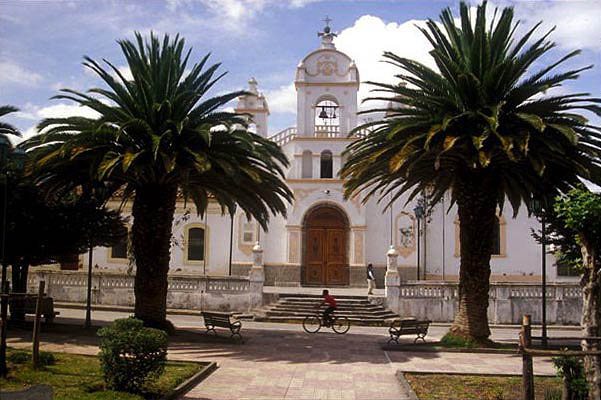
Breakfast. At the foot of the Imbabura Volcano, surrounded by clear lakes, patchwork-covered hills and plantations of corn, lies the valley of Otavalo, a market town ensconced in its own mystical past and whose people are proud of their cultural heritage and traditions. Visit the ruins of the Incan Sun Temple at Caranqui, then choose between two options. For those more interested in native cultures, visit the village of Peguche, where musical instruments and woolen tapestries are made, the nearby sacred waterfall and other artisans' pueblos. For those more interested in nature, drive up to Cuicocha Lake and hike around this flooded volcanic crater with its twin islets. Here, you will observe a particular species of orchid that grows at this altitude (3,220 meters, or 10,562 feet).
Iglesia de San Vicente Ferrer, Quiroga, Otavalo Valley, Ecuador.
Photo: Mylene d'Auriol Stoessel. Luxury Galapagos Cruises.
Time to explore the Otavalo Indian market, which dates back to pre-Inca times. The market is an experience for all senses: the aromas of traditional fare, soothing Andean panpipes, a kaleidoscope of colors, soft alpaca scarves and customary bargaining. The Otavaleños are owners of a rich inheritance, the customs of their craft; lovers of the rhythm of their music and their dance; and disciples of the legends of their earth mother, Pachamama. Experience an encounter with this proud race of people, whose cultural integrity endures, and discover ancient haciendas, authentic workshops and the incredible landscapes and lagoons of these fertile lands of the Gods.
Hacienda Cusín, Otavalo Valley, Ecuador.
Photo: Mylene d'Auriol Stoessel. Luxury Galapagos Cruises.
Lunch at the Hacienda Cusín. Cusín was purchased by the prominent Luna family from King Philip II at an auction in Spain in 1602. The estate comprised the two valleys of Gualavi and La Rinconada, and all the land between the valleys and the lake, approximately 100,000 acres. During the last 400 years, Hacienda Cusín remained, for the most part, in the hands of two different Spanish families and was operated as a farm. After falling into ruins after several decades of neglect, the hacienda was restored in 1990 and opened for international tourism.
Iglesia de San Pablo and the Imbabura Volcano, Otavalo Valley, Ecuador.
Photo: Mylene d'Auriol Stoessel. Luxury Galapagos Cruises.
Continue to Cayambe's very own "Middle of the World" Monument, marking the equator, then see how the pueblo's traditional biscuits and cheese are made. Returning to Quito under the shadow of the Cayambe Volcano, arrive at the palatial Casa Gangotena. Dine at Zazu, where chef Alexander Laud creates a fusion of South American and international cuisine. Overnight in the Casa Gangotena.


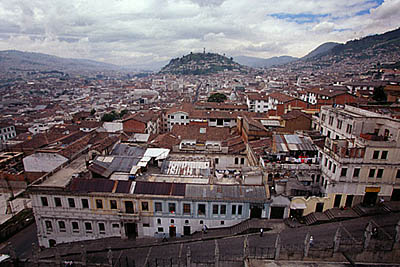
Colonial Quito with
El Panecillo in the distance, Ecuador.
Photo: Dan Heller. Luxury Galapagos Cruises.
Under the diadem of the Incas, Quito assumed a magnificence which it never saw before and has not displayed since. It was the worthy metropolis of a vast empire stretching from the equator to the desert of Atacama, and walled in by the grandest group of mountains in the world. On this lofty site, which amid the Alps would be buried in an avalanche of snow, but within the tropics enjoys an eternal spring, palaces more beautiful than the Alhambra were erected, glittering with the gold and emerald of the Andes. But all this splendor passed away with the sceptre of Atahuallpa...
-- James Orton, Andes and the Amazon, 1870
Day 7: Quito
Breakfast. Quito has the best-preserved historic district in South America. It is located on an active volcano, 9,300 feet above sea level in the Andes mountains. The city's origins date back to the first millennium, when the Quitu tribe occupied the area and eventually formed a commercial center. The Quitu were conquered by the Caras tribe, who founded the Kingdom of Quito about 980 AD. In 1462, the Incas conquered that kingdom and created a majestic capital for their northern empire. In 1533, Rumiñahui, an Inca war general, razed the city to prevent the Spaniards from taking it, thereby destroying any traces of the prehispanic metropolis. In 1534, the Spanish conquistadores invaded, and Francisco Pizarro founded San Francisco de Quito. Walking along its cobblestone streets through centuries-old parks and plazas to churches filled with gold, you will imagine you've gone back in time to the astonishing colonial world.
Source: Adapted from www.worldheritagesites.org.
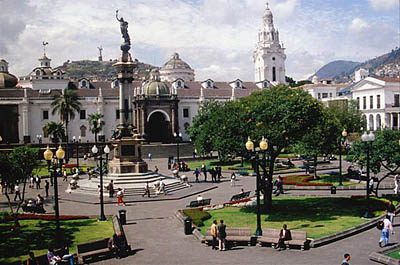
La Plaza de la Independencia, Quito, Ecuador.
Photo: Mylene d'Auriol Stoessel. Luxury Galapagos Cruises.
This morning, drive to the top of El Panecillo. The significance of this hill dates back to Inca times, when it was known as Shungoloma ("hill of the heart") and used as a place to worship the sun. Its summit overlooks Old Quito and is crowned by a winged statue of the Virgin. Begin your walking tour of the colonial quarter at La Plaza de la Independencia, where the country's history was written. On one side is the Cathedral (1640), considered to be the oldest in South America. Down Calle de las Siete Cruces (Street of the Seven Crosses) is La Compañia de Jesús (1605), one of the great baroque masterpieces of the continent. Also in the baroque style is the oldest of South America's colonial churches, La Iglesia de San Francisco (1535). It was constructed over the Inca Palace of Atahualpa and decorated with images of the sun to lure in the native people. The Moorish style of La Iglesia y Convento de la Merced is most likely explained by artists seeking refuge in South America after the expulson of the Moors from Spain. Started in 1538, the church was rebuilt in 1737. At the City Museum, see what daily life was like in colonial Quito.
El Pucará de Rumicucho, Quito, Ecuador.
Photo: Erythren. Luxury Galapagos Cruises.
Lunch of Ecuadorian or international cuisine by chef Carlos Alvear at El Crater, inside the Pululahua Volcano. Our afternoon destination is Rumicucho, a late 15th century Inca fortress, observatory and temple of the sun. It was built near the equator, which the Incas called Intiñan (Path of the Sun). Rumicucho was strategically located to allow communication by smoke signals with the ceremonial center of Cochasqui, 9 miles to the east, and with Quito's El Panecillo and the Palace of Atahualpa, 17 miles to the south. Before returning to Quito, go to the equator, where you can stand with one foot in the southern hemisphere and the other in the northern hemisphere. Don't be fooled by the Equatorial Monument, which isn't in the true position.
As an alternative, you may choose an afternoon excursion to the Central Bank Museum.
This afternoon, a lunch of traditional Ecuadorian cuisine by chef Juan José Loaiza at Café Tianguez. To complete your insight into the country's archaeology, history and cultures; investigate Ecuador's ancient past in the pre-Inca, Inca and colonial galleries of the Central Bank Museum. The Incas believed that gold nuggets were the tears of the sun, and one of the galleries, the Golden Court, dazzles the visitor with the gold masks and figurines they fashioned to worship their deity.
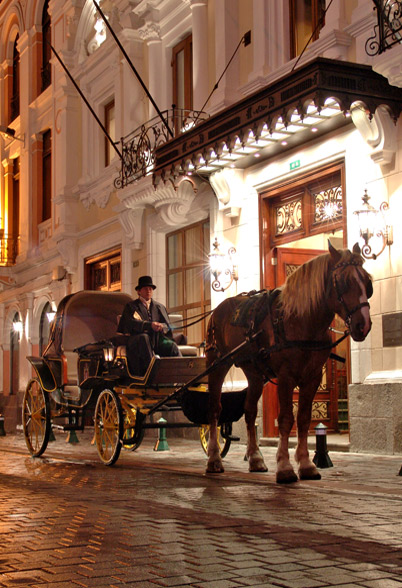
Traditional horse-drawn carriage, Quito, Ecuador.
Photo: Hotel Plaza Grande. Luxury Galapagos Cruises.
This evening, return to El Panecillo for a panorama of the beautifully illuminated colonial quarter. Though not of colonial vintage, the neo-Gothic La Basílica is the place to see bizarre and fascinating gargoyles in the form of giant tortoises, iguanas, anteaters, monkeys, pumas, condors and other Ecuadorian fauna. Admire the night view of the Spanish monuments along Calle de las Siete Cruces, on the way to La Plaza de la Independencia, where you will board a horse-drawn carriage for a romantic ride through the narrow streets of Old Quito. Arrive at Theatrum to savor vanguard Mediterranean cuisine by chef Julio Jose Avendaño Ostolaza. Afterward, return to your hotel. Overnight in the Casa Gangotena.
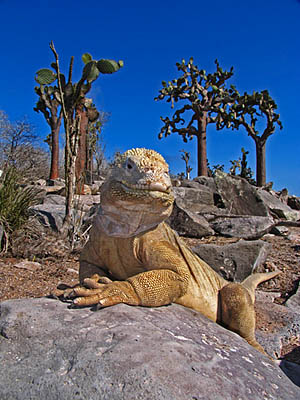
Land iguana and opuntia cacti, Galapagos Islands.
Photo: Ron Dahlquist. Luxury Galapagos Cruises.
We seem to be brought somewhat near to that great fact
-- that mystery of mysteries --
the first appearance of new beings on this earth...
The natural history of these islands is eminently curious, and well deserves attention. Most of the organic productions are aboriginal creations, found nowhere else; there is even a difference between the inhabitants of the different islands; yet all show a marked relationship with those of America, though separated from that continent by an open space of ocean, between 500 and 600 miles in width. The archipelago is a little world within itself, or rather a satellite attached to America, whence it has derived a few stray colonists, and has received the general character of its indigenous productions. Considering the small size of the islands, we feel the more astonished at the number of their aboriginal beings, and at their confined range. Seeing every height crowned with its crater, and the boundaries of most of the lava-streams still distinct, we are led to believe that within a period geologically recent the unbroken ocean was here spread out. Hence, both in space and time, we seem to be brought somewhat near to that great fact -- that mystery of mysteries -- the first appearance of new beings on this earth.
-- Charles Darwin, Voyage of the Beagle, 1845
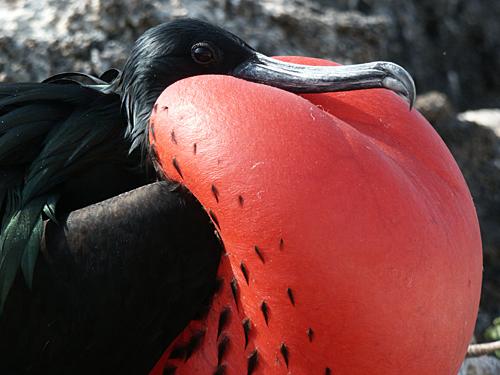
Male frigate bird displaying,
Galapagos Islands.
Photo: Marco Robalino. Luxury Galapagos Cruises.
From so simple a beginning endless forms most beautiful and most wonderful
have been, and are being evolved...
Thus, from the war of nature, from famine and death, the most exalted object which we are capable of conceiving, namely, the production of higher animals, directly follows. There is grandeur in this view of life, with its several powers, having been originally breathed by the Creator into a few forms or into one; and that, whilst this planet has gone cycling on according to the fixed law of gravity, from so simple a beginning endless forms most beautiful and most wonderful have been, and are being evolved.
-- Charles Darwin, On the Origin of Species by Means of Natural Selection, 1859
Sea turtle, Galapagos Islands.
Photo: Bonnie Pelnar. Luxury Galapagos Cruises.
Northern Islands
Day 8: Quito - Galapagos Cruise (Baltra Island & Santa Cruz Island)
Breakfast. Early morning transfer to the airport for the flight to Baltra Island (27 sq. km.). The flora on this small island include introduced species of cacti and the native species of palo santo, susevium and mangrove. Fauna include land iguanas, marine iguanas and sea turtles. There are no visitors' sites. Arrival, reception and transfer south to your yacht in Puerto Ayora, on Santa Cruz Island. Briefing on the ship and the Galapagos Islands by your guides and staff of the Galapagos National Park.
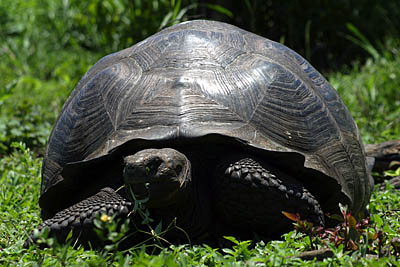
Giant tortoise, Galapagos Islands.
Photo:
David Bate. Luxury Galapagos Cruises.
Santa Cruz Island (986 sq. km.) is the second largest in the archipelago and the most populated. Home to the Charles Darwin Research Station, it has many trails, beaches and places for snorkeling. Flora include cacti, saltbrush and mangroves. Fauna include several of the 11 remaining subspecies of giant tortoises, marine iguanas, sharks and various species of waterbirds and landbirds, such as vermillion flycatchers and Darwin's finches. Afternoon excursion to the Santa Cruz Highlands, where you will observe Los Gemelos, twin volcanic craters, and Cerro Chato. Chances are good for sighting the famous giant tortoises that gave these islands their name. Additionally, you can walk inside the dormant lava tubes. Overnight on La Pinta.
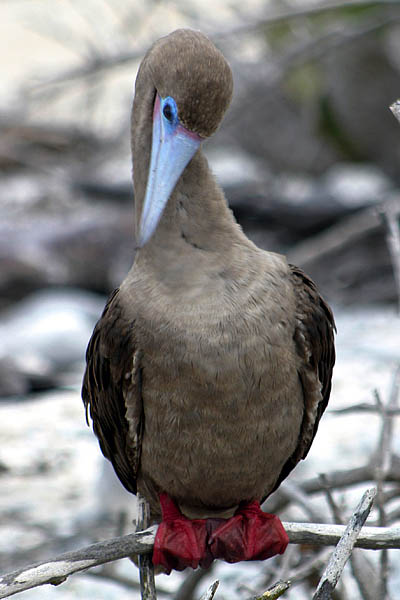
Red-footed booby, Galapagos Islands.
Photo:
David Bate. Luxury Galapagos Cruises.
Day 9: Galapagos Cruise (Rabida Island & Santiago Island)
Rabida Island (5 sq. km.) is small with red-hued beaches and volcanic formations. Its color is due to the high content of oxidized iron in the lava. Dry landing at the red beach frequented by sea lions. A short trail leads to a saltwater lagoon, where we will find small colonies of flamingos feeding. The brown pelicans nest in the mangroves found on the far side of the lagoon. Other island fauna include white-cheeked pintail ducks, boobies and nine species of Darwin's finches. A 750-meter trail leads to a volcanic peak covered with aromatic but bare-branched palo santo trees and ends at a great snorkeling spot. Hike, snorkel and ride out in a dingy to the reefs.
Goldrimmed surgeonfish, Galapagos Islands.
Photo: Bonnie Pelnar. Luxury Galapagos Cruises.

Santiago Island (585 sq. km.) is the fourth largest in the archipelago. The eroded shapes on its black lava shoreline form pools that house a variety of wildlife and are wonderful for snorkeling. Wet landing on the dark-sand beach at Puerto Egas. Most of the landscape is tuff-stone layers and lava flows; the surroundings are prime for observing Darwin's finches, Galapagos doves, Galapagos hawks, hunting herons, great blue herons, lava herons, American oyster catchers and yellow-crowned night herons. You will enjoy the sight of marine iguanas grazing upon algae beds at low tide, sharing space with red Sally light-foot crabs. There is a colony of fur seals swimming in deep pools of cool water, called "grottos". This is an excellent place for swimming and snorkeling in search of octopuses, sea horses, starfishes and other sea life caught in the small tidal pools. In the ocean, you can admire moray eels, hammerhead, white-tip and Galapagos sharks, golden and white-spotted eagle rays, jacks, wahoos, tunas, groupers, red-tailed and dog snappers, sea lions, sea turtles (November to May), black and yellow-black Galapagos corals, sea fans and sponges. Overnight on La Pinta.
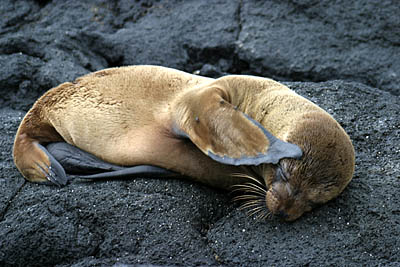
Juvenile seal lion,
Galapagos Islands.
Photo: David Bate. Luxury Galapagos Cruises.
Day 10: Galapagos Cruise (Fernandina Island & Isabela Island)
Fernandina Island (642 sq. km.) is the third largest, youngest and westernmost in the archipelago. Many eruptions have been recorded since 1813, making Fernandina the island most likely to become volcanically active. After a dry landing at Espinoza Point, you will see the largest colony of marine iguanas in the islands, mingling with Sally light-foot crabs. Other fauna include Galapagos penguins, Galapagos hawks and sea lions. There are also nesting sites of flightless cormorants. These birds have adapted to their environment by perfecting their ability to hunt for food in the ocean -- their wings, tails and feet have evolved for swimming. To see these birds is to witness evolution in action. Among the volcanic formations, observers will note "pa-hoe-hoe", other unusual lava formations and recent lava flows. Flora include brachycereus cacti and mangroves, whose beds extend into the sea, indicating a healthy and thriving ecosystem.
Swimming Galapagos penguin, Galapagos Islands.
Photo: Bonnie Pelnar. Luxury Galapagos Cruises.
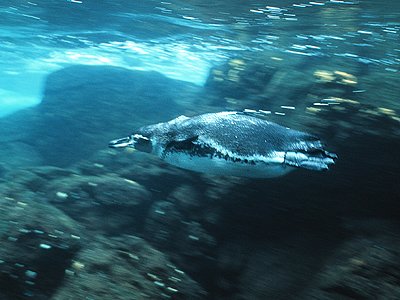
Isabela Island (4,588 sq. km.) is the largest in the archipelago. It is formed by five young, active volcanoes, of which Volcano Wolf is the highest point in the Galapagos (1,707 meters, or 5,599 feet). On a panga ride along the cliffs of Tagus Cove, look for Galapagos penguins and other sea birds before making a wet landing at Urbina Bay. The bay, at the foot of the Alcedo Volcano, was uplifted from the sea in 1954. Flightless cormorants and pelicans nest along the coast, and sea turtles and manta rays can be seen in the bay. The highlands include large and colorful land iguanas. Other fauna include the largest population of giant tortoises (about 4,000 but difficult to spot), Galapagos hawks, magnificent frigate birds, marine iguanas, hammerhead, white-tipped and Galapagos sharks, eels, groupers and snappers. Continue to Punta Vicente Roca for dinghy sightseeing, snorkeling and scuba diving. Enjoy the high cliffs with tuff-stone, ash and other lava formations; caves; nesting sites for brown noddies and blue-footed boobies; and up-close encounters with sea lions, fur seals and the occasional dolphin. Overnight on La Pinta.
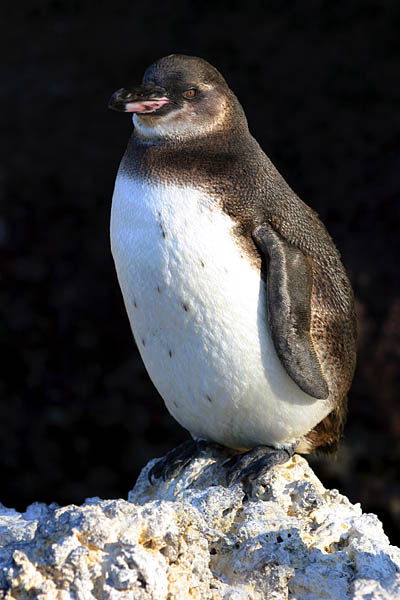
Galapagos penguin, Galapagos Islands.
Photo:
David Bate. Luxury Galapagos Cruises.
Day 11: Galapagos Cruise (Bartolome Island & Santa Cruz Island)
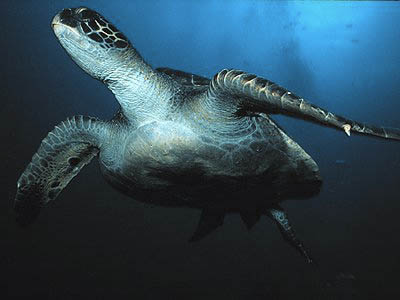
Bartolome Island (1.2 sq. km.), small and moonlike, has one of the most famous sights in the archipelago: Pinnacle Rock. After a dry landing, you will see volcanic formations, including lava bombs, spatter and cinder cones. Hike to the summit for an impressive panorama of Sullivan Bay, including the eroded tuff cone of Pinnacle Rock, and the surrounding islands. The exotic flora of red mangroves, tiquilias and cacti all add to the experience. During the ascent, you will see a large colony of marine iguanas and lava lizards. Snorkeling will give you a chance to cool off and see marine fauna, such as Galapagos penguins, nesting sea turtles (January to March) and white-tipped sharks.

Sea turtle, Galapagos Islands.
Photo:
David Bate. Luxury Galapagos Cruises.
Santa Cruz Island. On an excursion to Black Turtle Cove, located near Las Bachas Beach in the north of the island, take a panga ride though the mangroves, during which the outboard motor of the small boat is turned off, allowing close observation of sea turtles, white-tipped reef sharks, spotted eagle rays and yellow rays. Overnight on La Pinta.
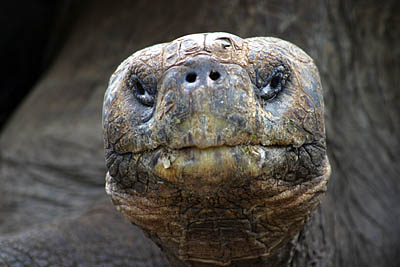
Giant tortoise, Galapagos Islands.
Photo:
David Bate. Luxury Galapagos Cruises.
Day 12: Galapagos Cruise (Santa Cruz Island & Baltra Island) - Quito
Morning visit to the Charles Darwin Research Station, staffed with international scientists conducting biological research and conservation projects. Here, you can admire giant tortoises, part of the program to breed, rear and reintroduce different subspecies of tortoises back into their natural habitat. Surrounding the station is an impressive giant prickly-pear cactus forest with many land birds. Afterward, some free time to walk around the town of Puerto Ayora. Transfer to the Baltra Island airport for the flight to Quito. Arrival, reception and transfer to your hotel. Dinner at Astrid & Gastón of chef Gastón Acurio. Like the original in Lima, this restaurant incorporates local dishes and ingredients in its sophisticated Criollo cuisine. Overnight in the Casa Gangotena.
Important note: This itinerary is subject to change without notice for various reasons, including but not limited to safety, weather, mechanical breakdown, unforeseen emergencies, and the discretion of the captain, guide, yacht operator and Galapagos National Park.
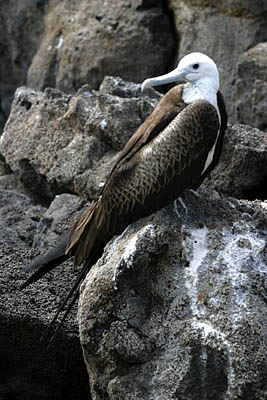
Magnificent frigate
bird, Galapagos Islands.
Photo: David Bate. Luxury Galapagos Cruises.
Day 13: Quito - Home
Breakfast. Early transfer to the airport for your flight home.
© 2013 Inka's Empire Corporation, Machu Picchu Luxury Tours. All rights reserved.